Showing posts with label Opinion. Show all posts

Tuesday, April 16, 2013

Have our worst fears been realized?

The April 15th attacks on runners and innocent bystanders at the Boston Marathon were tragic and have sparked an outpouring of support across America and the world. Shortly before 3 pm  nearly 5 hours after the race began, one device exploded near the finish line behind a crowd of spectators. Seconds later the second blast occurred. The two devices were what is commonly referred to as IEDs (Improvised Explosive Devices) and usually contain all manner of material crudely designed to cause as much damage in as short a time as possible.

Just seconds after the initial blast law enforcement and off-duty military personnel began assisting in getting the wounded away from the area and to safety. In one video from The Boston Globe at least three uniformed military members could be seen pulling aside the mangled barriers that were blocking first-responders' access to the victims. What has universally been called remarkable is the response time by those at the scene. Quite literally it was seconds.

While the local police may be confused and confounded as to how this could happen, who would do this, and why perhaps it is the military that knows the answers. Since September 11, 2001 when Al Qaeda terrorists hijacked multiple planes the United States has been engaged in wars in Afghanistan and Iraq. It is common for military members to lose their lives overseas not just by gun-fire but also by explosions caused by roadside bombs or IEDs. But still it is not just along the roads and the patrol routes that our military men and women must take extreme caution, it is within Iraqi and Afghan schools, mosque's (churches), and government buildings. Sometimes by the dozens innocent men women and children have been killed due to these attacks. However these types of incidents have been absent in America and other leading countries...until now.

One of the "changes" that were implemented after 9/11 was a series of protocol to prevent a terrorist's ability to gain access to an airliner for lethal intent. Americans have been subject to increased security at Airports and to travel abroad.  In addition a new government department was created: The Department of Homeland Security and with it a slew of measures to ensure that authorities could locate and disarm individuals seeking to cause acts of terror. Up until now this has worked well. The international community has effectively stopped terrorists from hijacking another plane. Under the guidance of President George W. Bush and President Barack Obama the world watched as Al Qaeda was beaten back on their own turf and slowly but surely victories in the middle-east came rolling in. The fall of Saddam Hussein and successful establishment of a democracy in Iraq, the assassination of Osama Bin Laden, the targeting and killing of dozens of top Al Qaeda leadership. Perhaps America was lured into a false sense of security.

We still don't know who caused the attacks at the Boston Marathon. It is unknown if this was domestic or foreign terrorism, though terrorism it was. There are two scenarios: 1. It was foreign terrorism and that means that a new "Achilles heel" has been realized, or 2. It was domestic terrorism and that means our enemies are watching.

For all our heightened security and sense of self-awareness perhaps our greatest weakness is where we interact daily with  the world. At our jobs, our schools, our churches. It would be far easier for a terrorist to target these public places that frequently have no security except the one guy at the front desk of the building. For over a decade terrorists from Al Qaeda and other organizations of unsuccessfully targeted airliners to get at Americans and other nations when the easiest route of all was down main street USA.

And so American will have to face a choice and the two options are not very desirable  Either we sacrifice more rights and liberties so that our law enforcement officials can better secure our communities or we live in a state of fear. Perhaps since the Cold War America has lived a sheltered life. While we read in the "Foreign Affairs" section about a IED that killed 20 children or 38 soldiers somewhere in the middle east we don't blink because it's happening on some distant country. What if it became our country and our problem?

I'll finish with words of guidance a founding father provided over 200 years ago:
"Those who would trade in their freedom for their protection deserve neither. Those who give up their liberty for more security neither deserve liberty nor security."

Friday, February 22, 2013

Opinion: U.S. Drug Czar On Marijuana Legalization


A recent article, which was featured in the 2/22 'Morning Report', detailed how the current United States Drug Czar from the Obama administration stated that the feds would be "going after" distributors of marijuana in Colorado and Washington state. This came as a surprise to us as the administration has previously stated that they would not concern themselves with the goings-on in CO and WA regarding pot legalization. We decided to look into things and came across with a better understanding of the situation that, while it may not necessarily change the trajectory of the remarks, should provide context to Mr. Kerlikowske's statement. Read our opinion report below:

Mr. Kerlikowske is, as he is statutorily required to do, doing (and saying) whatever he needs to to prevent the legalization of cannabis. It's codified into his job description and duties.
So, when he says:
"I think a patchwork of policies would create real difficulties. We still have federal law that places marijuana as being illegal. The administration has not done a particularly good job of, one, talking about marijuana as a public health issue, and number two, talking about what can be done and where we should be headed on our drug policy."
This is true. The White House, and for that matter the DEA, ONDCP, DHHS and a myriad of other Federal agencies continue to insist that cannabis is more dangerous than cocaine, methamphetamine  prescription opiates, alcohol and tobacco. They assert cannabis is a gateway drug, despite statistics that show 91% of users never go on to harder drugs. And they all work actively together to cage people, deny them health and welfare benefits, take children away and all manner of oppression. So yeah, no one in government has any credibility on the issue. Kinda happens when you lie openly for forty years.
"I don’t look at marijuana as a human right, or a civil right, or even in the same venue as gay marriage. This is a public health issue. There are significant health concerns around marijuana from all the science, not ideology. I don’t see the legalization of drugs and making them widely available as a good thing, and I don’t think locking everyone up is a good thing either."
I've yet to see a cop of any kind on active duty who thinks cannabis is a human right. That doesn't mean it is not a human right. History has NEVER ONCE shown an example of laws prohibiting people from doing what they want with their bodies and lives. No, at the very core, a Prohibitionist is motivated purely by ignorance, envy, greed or hatred.
"Our Congress has made it very clear on these issues that if we feel we lack sufficient legislation, given what we've suffered from, the deaths—particularly in poverty-stricken areas of Appalachia—then we should ask for additional authorities.
What we've done is to say once the problem has been identified and been well-publicized, then our elected officials have been very helpful."
Translation: "Whenever a new substance is invented or discovered, we quickly push to make it illegal. We would rather codify into law a criminal market, absent regulations for quality and safety. We would prefer to enrich criminals, and fight with them. We will make sure we block all requests for research, and will conduct powerful raids with automatic weapons, attack helicopters, and maybe even a fighter jet or two if a kingpin gets too out of line. We will also rev up the propaganda machine and ensure that no one is looking at our massive failure to effect supply or demand of any substance. And we can sucker unwitting politicians into this trap EVERY SINGLE TIME! Look how quick we got everyone to lay down immediately on synthetic marijuana. They didn't even ask if cannabis prohibition itself was the cause of this stuff. It's like shooting fish in a barrel they're so stupid and shortsighted."
"We arrest about 2.4 million people in this country a year for alcohol. We arrest less than 700,000 people for marijuana—and for all drugs, only 1.3 million. Alcohol is perfectly legal. So making drugs available without any sanction would only lead to more abuse."
To come to that conclusion, a person has to willfully ignore the results from Portugal, where we have 10 years of decriminalization of ALL drugs, not just cannabis. The results? Significant decreases in overdose deaths, HIV/hepatitis infections, long term dependency, usage by adults in all age categories, and most importantly among youths. There have also been marked declines in petty crime such as theft and vandalism, and a voluntary treatment program is resulting in better long term recovery rates. Did I mention the savings reaped from fewer arrests, court cases and incarcerations?
Of course, Kerlikowske is on record as saying he doesn't think the experience of Portugal will be matched here. Apparently, basic human behavior is different in Portugal than in the rest of the world.
"The other part is if people go into drug treatment—and the research bears this out clearly—if they knock on the door and say, look, I have a drug problem and I need help, or if they go in with handcuffs on—the outcomes are pretty similar. The criminal justice system, if it has the right resources, can be incredibly helpful at getting people into treatment."
The same miserable results: 1 in 20 who enter addiction treatment remain abstinent for two years or longer. It's doesn't matter what the addiction is by and large. And I seriously doubt any cop, judge or prosecutor is qualified to determine what a person medically needs. It's a statement on the arrogance of Prohibitionists to presume they know what's best for people and how they should live. And he's lying when he says he doesn't think we should lock people up. If that were the case he'd ask his officers to ignore dispensaries. He wouldn't say in one sentence they aren't targeting individuals while they work diligently to remove the supply.
"In the U.S., we really pushed our pharmaceutical industry to develop the abuse-resistant formulas. But if they are easily accessible in Canada, you will see them here. Our first seizure of these was in Milwaukee. So we are keeping a close eye to see if we see others."
'Pushed' is the proper term for these goons. And to the net result that opiate addiction is still a major problem. Only, the goons have scared ethical physicians into not prescribing needed pain medication, leaving patient's legitimately suffering and having to find relief in the black market, or through pain clinics, where the entire regime is designed to keep the pills flowing without the DEA knocking down the doors. Patient care and long-term outcomes are way down the list of priorities, with physician profit being at the very top of the priority list.
To keep the DEA from kicking the doors in and shutting them down, they run drug screens and will kick anyone out of the program that tests positive for 'illicit drugs'. Remember, they are beholden to the police first, thanks to guys like Kerlikowske and his lack of concern for human rights. So naturally, that includes cannabis. Never mind the VAST bank of peer-reviewed studies showing analgesic and other specific benefits for pain. Never mind that patients CONSISTENTLY report having to use less opiates when they use cannabis. Never mind that cannabis has been shown a highly effective strategy to help opiate-dependent patients reduce their intake of opioids. None of those things matter. It's a Schedule I narcotic, and even though no one has ever died from cannabis in recorded history, and even though these myriad of promising medical benefits exist, guys like Mr. Kerlikowski insist otherwise. So if you test positive for any illicit drug, you are not entitled to painkillers in the program. And they wonder why they have no credibility in the public eye.
"Yes, they’d injected safely and hadn’t overdosed, but there was nothing else for them but to continue to get other drugs. I’m sure this will be a controversial statement."
Well, when you don't see this as a human rights issue, I guess you will still find some way to twist that into the notion that prohibiting something will reduce harms. Here's a clue Mr. Kerlikowske: you and your ilk have done nothing but CAUSE harm. You and those like you have endorsed, enforced, and participated with vigor in a program and Prohibition that has resulted in MILLIONS upon MILLIONS dead and suffering, lives ruined and turned upside down. It's resulted in $1 TRILLION of our tax dollaers being wasted. It's resulted in a public that sees the police and Feds as corrupt oppressors, and the public is correct. It's resulted in disrespect for the law (given 100,000,000 Americans have used cannabis in their lifetimes). And it's resulted in a cemented racial and class divide, with people of color and the poor being forever trapped in their situation because of this stupid law.
Every last lawmaker and law enforcement person who supports or enforces this law has an unconscionable legacy. Whether they accept it or not, their hands are stained with the blood of their citizens and the cries of agony for those denied relief. That's the truth.

Opinion: Why Is The Pope Checking Out So Soon?


There has been much speculation around Pope Benedict XVI’s resignation. For a week now, rumors have swirled on the internet that the Pope is retiring within the Vatican City to avoid arrest in some kind of lawsuit. Then, Thursday, the Italian daily newspaper La Repubblica reported that the Pope decided to resign Dec. 17, the day he received the findings of a probe into the “Vatileaks” affair, including allegations of a network of gay priests and the blackmailers they’d attracted.
Meanwhile, it was disclosed that Pope Benedict has undergone heart surgery, providing a reasonable explanation for leaving any job – except the one of being God’s chosen representative on Earth.
Reuters
The Pope cited his “incapacity to adequately fulfill the ministry entrusted to me” in “today’s world, subject to so many rapid changes.” This was the same week the producers of Maker’s Mark announced they were lowering the alcohol content of their bourbon: Here was the leader of the Catholic church bemoaning his inability to adapt to a changing world. Has everyone forgotten their brand? Since when did the Catholic church agonize over its inability to respond to change? Not responding to change is what the church does best.
But then, on the heels of the Pope’s announcement another story broke, almost as though he’d sought to get in front of it – a story I like to believe is more likely to explain his hasty retirement: A team of Japanese scientists has announced the discovery of a sea slug that has a disposable penis.
Sea slugs are hermaphrodites. As human knowledge grows, God’s occasional whimsicality with sex organs is something the church has had to confront. An animal with both sets raises questions for a church so particular about gender roles. And given that Pope Benedict XVI’s predecessor, John Paul II, took the position that animals have souls, the soul of a sea slug in a body possessed of two sets of sex organs might have been a worry to the pontiff.
Sea slugs mate with both sets of sex organs, concurrently. I imagine (reminding you that sin lies not in the desire, but only in acting upon that desire) that double-sex must be a pretty tempting proposition, one that could lead many a sea slug astray. Twice. And at the same time. Sea-slug Craigslist postings must be novella length. Questions abound: Does the involvement of four sex organs automatically make the most mundane Monday-night, post-“let’s-see-what’s-on-Netflix” sea-slug encounter an orgy?
I’m guessing that the church would sanction that, provided the sea slugs really concentrated on what went where, with no funny stuff – but remember, sea slugs live underwater, and are at the mercy of the currents. Two pious sea slugs could be lining up their organs just fine, by the book, and then suddenly a large tuna, say, could swim over them. The poor little things could get flipped around in the act of procreation and suddenly they’d be having a big, gay, tuna-induced orgy. One wave and the purest of sea-slug couples attempting to form a blessed union might inadvertently find him/herself and him/herself in an aquatic version of Satyricon.
I’d like to believe that while these things weighed heavily on him, like other popes before him, the Pope grappled with their theological implications, as was his lot, until news came of a sea slug that, post-coitus, drags his/her penis alongside him/herself for 20 minutes before casually discarding it and then growing anoth er one within 24 hours – and that proved too much. Consider the moral issues a detachable penis raises: If one of God’s creatures uses a different penis every time he has sex, is he a virgin each time? Would any sea slug drawn into the service of the Lord have to stop being a priest for the 24 hours she didn’t have a penis?
All of this would be enough to throw any pontiff into spiritual crisis, but, what’s more, the sea-slug penis in question appears to be covered with tiny spines that scrape out any competing sperm inside the vagina-like organ of his/her partner as he himself attempts fertilization. Thus, he disposes of his rival’s seed when he ditches his used penis. We’re confronted with a removable penis that is also an effective, though selective, form of birth control. What Pope wouldn’t feel overwhelmed?
Word has it that Benedict will issue a decree speeding up the process of appointing his replacement. While the pontiff is fatigued, he recognizes that there must be guidance – during this, the age of the disposable penis.

Monday, February 18, 2013

House Freezes Pay For Federal Workers

In 2010 the federal government had enacted a two year freeze on cost of living adjustments for federal employees, an austerity measure championed by President Obama. More recently democrats had lifted that freeze and sought small increases for federal workers.

However on Friday House Republicans voted to extend the pay freeze for another nine months. In doing so they argue that federal workers should not get pay increases while many Americans in the private sector are not getting them.

But while both Congress and the President have championed pay freezes for federal employees at some point over the past two years, one group has gotten away with earning enormous salaries at taxpayer expense: defense contractors.

Defense contractor pay is currently capped at $763,000 which is almost twice what President Obama's salary is. Last December, Democratic Senator Joe Manchin (D-WV) inserted a measure into the defense authorization bill that would've capped these salaries to $230,700 -- the salary of the Vice President.

Unfortunately this measure did not make it into the final bill which simply promised to study the contractor pay cap.

Essentially the House Republicans are saying that hard working employees at the Environmental Protection Agency or Federal Bureau of Investigation should have their salaries frozen, but if you work for Lockheed Martin or Halliburton, you can continue to fleece the American taxpayers. 

Thursday, February 7, 2013

So God Made A Banker

www.shutterstock.com

And on the eighth day God looked down on his planned paradise and said, “I need someone who can flip this for a quick buck.”
So God made a banker.
God said, “I need someone who doesn’t grow anything or make anything but who will borrow money from the public at 0% interest and then lend it back to the public at 2% or 5% or 10% and pay himself a bonus for doing so.”
So God made a banker.
God said, “I need someone who will take money from the people who work and save, and use that money to create a dotcom bubble and a housing bubble and a stock bubble and an oil bubble and a commodities bubble and a bond bubble and another stock bubble, and then sell it to people in Poughkeepsie and Spokane and Bakersfield, and pay himself another bonus.”
So God made a banker.
God said, “I need someone to build homes in the swamps and deserts using shoddy materials and other people’s money, and then use these homes as collateral for a Ponzi scheme he can sell to pensioners in California and Michigan and Sweden. I need someone who will then foreclose on those homes, kick out the occupants, and switch off the air conditioning and the plumbing, and watch the houses turn back into dirt. And then pay himself another bonus.”
God said, “I need someone to lend money to people with bad credit at 30% interest in order to get his stock price up, and then, just before the loans turn bad, cash out his stock and walk away. And who, when asked later, will, with a tearful eye, say the government made him do it.”
God said, “And I need somebody who will tell everyone else to stand on their own two feet, but who will then run to the government for a bailout as soon as he gets into trouble — and who will then use that bailout money to help elect a Congress that will look the other way. And then pay himself another bonus.”
So God made a banker.

Wednesday, January 30, 2013

Mark Kelly Unmasks Wayne LaPierre

Associated Press

Mark Kelly, husband of Gabrielle Giffords, revealed the NRA position on guns for the sham that it is, as Greg Sargent notes. LaPierre’s argument that that there’s no need to expand background checks because criminals won’t cooperate was shot down,as Kelly testified:
The Tuscon shooter was an admitted drug user. He was rejected from the U.S. Army because of his drug use. He was clearly mentally ill. And when he purchased that gun in November, his plan was to assassinate my wife and commit mass murder at that Safeway in Tucson. He was a criminal. Because of his drug use, and because of what he was planning on doing. But because of these gaps in the mental health system, in this case, those 121,000 records, I admit did not include a record on him. But it could have.
And if it did, he would have failed that background check. he would have likely gone to a gun show, or a private seller, and avoided that background check. But if we close that gun show loophole, if we require private sellers to complete a background check, and we get those 121,000 records and others into the systems, we will prevent gun crime. That is an absolute truth. It would have happened in Tucson. My wife would not have been sitting here today if we had stronger background checks.

Saturday, January 26, 2013

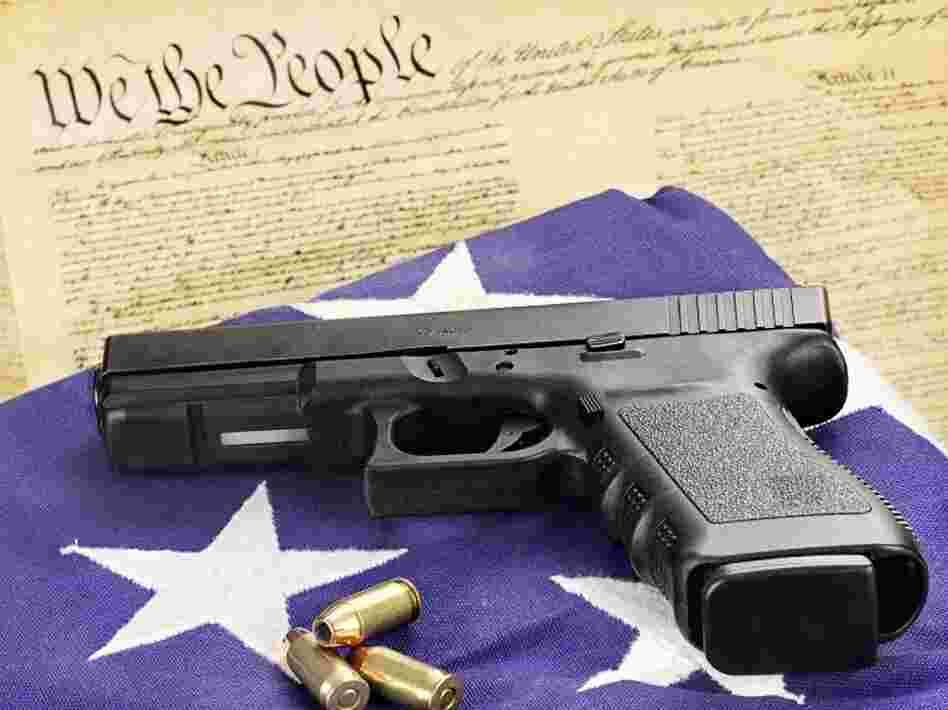
Opinion: The Real Reason For The Second Amendment


There are two versions of the text of the Second Amendment, each with slight capitalization and punctuation differences. The Second Amendment, as passed by the House and Senate, reads:
A well regulated Militia, being necessary to the security of a free State, the right of the people to keep and bear Arms, shall not be infringed. 
The original and copies distributed to the states, and then ratified by them, had different capitalization and punctuation: 
A well regulated militia being necessary to the security of a free State, the right of the People to keep and bear arms shall not be infringed. 
Both versions are commonly used in government publications.

Have you ever wondered just what was meant by these infamous words? There is no other amendment that has gone  through more scrutiny and interpretation than the Second Amendment. In District of Columbia v. Heller the Supreme Court tackled this, and many people were upset with Justice Scalia's reading and interpretation of the Second Amendment.

Yer after having done some research I feel that Scalia was absolutely right to determine the Second Amendment applies to an individuals right to bear arms. Furthermore, reading some of the quotes from our Founding Fathers has led me to believe their primary intent was something I have never heard before now:
The true purpose of the Second Amendment was/is to protect the people from the oppression of their own government. 
In other words, the Second Amendment ensured the people would have the means to fight back, if it ever became necessary. Sound believable? Check out some of these quotes...
"The best we can hope for concerning the people at large is that they be properly armed." - Alexandr Hamilton, The Federalist Papers at 148-8.
"The great object is that every man be armed. Everyone who  is able might have a gun." - Patrick Henry
"The Constitution shall never be construed to authorize Congress to prevent the people of the United States, who are peaceable citizens, from keeping their own arms." - Samuel Adams, debates & Proceedings in the Convention of the Commonwealth of Massachusetts, 86-87.
"No free man shall ever be debarred the use of arms." - Thomas Jefferson, Proposal Virginia Constitution, 1 T Jefferson Papers, 334 (C.J. Boyd, Ed., 1950)
"Experience hath shewn, that even under the best forms  [of government], those entrusted with power have, in time, and by slow operations, perverted it into tyranny." - Thomas Jefferson, Bill for the More General diffusion of Knowledge (1778)
"The Constitution preserves the advantage of being armed  which Americans possess over the people of almost every other nation...(where) the governments are afraid to trust the people with arms." - James Madison
"Before a standing army can rule, the people must be disarmed; as they are in almost every kingdom of Europe. The supreme power in America cannot enforce unjust laws by the sword; because the whole body of the people are armed, and constitute a force superior to any bands of regular troops that can be, on any pretense, raised in the United States." - Noah Webster, An Examination into the Leading Principles of the federal Constitution (1787) in Pamphlets to the Constitution of the United States (P. Ford, 1988)
For me there is no doubt that the true intent of the Second Amendment was to protect the people from their own government. Considering all of what they experienced and witnessed in their time, it seems a reasonable premise. 

However that was back when guns were only second to cannons. An armed citizenry was (more or less) equal to the military, in terms of weaponry and tactics...Nowadays, though, our military has so many ways to wipe us out it's scary. And, it's been that way for years. Yet, here we still are with our Constitution intact (many would probably argue against that statement). 

If the intent of the Constitution is to protect the citizens by allowing them the means to fight back, then something is really wrong here. It looks as if We the People are severely outmatched in weaponry by our own government's military. This isn't good.
But what is the solution? Arm the citizens with machine guns, tanks and bombers? Or, reduce the weaponry of our military? Neither sounds like a good idea to me.
Who knows what the answer is. But it is a dilemma.

Friday, January 25, 2013

The More Republicans Know About Politics, the More They Believe Conspiracy Theories


In the mainstream political press, the standard practices of neutrality and balance carry with them an implicit assumption: that Democrats and Republicans are separate but equal in their ideological biases, with each group just as inclined to support its own team and attack the other side. The trouble is, data from psychologists and political scientists suggest that this might be a naive approach. At worst, it may fundamentally misunderstand the nature of American politics.
The latest evidence on this head comes from pollster and political scientist Dan Cassino of Fairleigh Dickinson University. In a national survey, Cassino examined belief in political conspiracy theories on both the left and also the right. He did so by asking Americans about two "liberal" conspiracy beliefs—the 9/11 "Truther" conspiracy, and the idea that George W. Bush stole the 2004 election—and two conservative ones: the "Birther" theory that Barack Obama was born in Kenya, and the claim that he stole the 2012 vote.

Court opinion throws labor panel rulings, operation into question as White House slams decision


(photo from salon.com)


A federal court's ruling Friday that President Obama violated the Constitution with recess appointments to the National Labor Relations Board opened the door to claims that a host of rulings and other past appointments may be in question, as the White House blasted the decision as unfounded. 

The administration is expected to appeal. Though White House Press Secretary Jay Carney would not confirm that, he called the ruling "novel and unprecedented." 
"It contradicts 150 years of practice by Democratic and Republican administrations. So we respectfully but strongly disagree with the ruling," Carney said.

He denied that the ruling would have any bearing on other decisions and appointees. "This is one court, one case, one company," Carney stressed.

But Republican lawmakers who have railed against the administration's recess appointments, as well as the often union-favoring decisions of the NLRB, rejected that view. 


Read more: http://www.foxnews.com/politics/2013/01/25/court-obama-appointments-are-unconstitutional/#ixzz2J20ASUbr


Wednesday, January 23, 2013

We Should Compare Guns To Cars

An increasingly common argument in the discussion over gun control is motor vehicle accident deaths. Liberals spit (figuratively) in disgust at the comparison but gun rights advocates are right. They argue that we don't blame the car, we blame the driver. Regardless of the object's intent neither the car nor the gun can maim without human touch. A car is for getting you from point a to point b at the very basic level, and a gun is for shooting targets, game, skeet and people.

I agree. Comparing guns and cars is actually fair. The two kill roughly the same amount of Americans every year: 33,687 motor vehicle deaths and 31,672 firearm deaths in 2010 (the last year complete data was available.) Also the death rates per 100,000 are almost identical: 10.9 to 10.3.

So why not legislate guns like we legislate vehicles.

  • Learners permit at age 15 and a formal test for a license at 16. This kind of law would prevent deaths of young children who are taken by their parents to firing ranges to "try out" weapons as well as in other situations. Just as a nine-year-old isn't allowed to drive a car so too shouldn't they be allowed to fire a 9mm Micro Uzi. Can one really argue that children firing automatic weapons was really the intent of the founding fathers when they crafted the second amendment. Hunting should be no exception. Kids can't drive a car or truck for any reason and nor should they be allowed to shoot a firearm. 
  • Require renewal of license every 2-3 years. I have to renew my driver's license in as such time so why shouldn't they? 
  • Require a different license for different classes of weapons. A driver of an 18 wheeler requires a different license. Handling a vehicle of that size with air brakes is very different from driving an automatic, 6 cylinder car. If you want to purchase a semi-automatic weapon it should require a different license. 
  • Registration. Cars have to be registered so all guns should be too. Remember the argument is that guns are no more lethal than cars. If it's good for the car it's good for the gun. Registering a weapon doesn't infringe on the right to own. Gun licensing and registration will also create more jobs. 
  • Require gun insurance. If I intend on driving my car I have to have insurance so that same standard should apply to guns. Safe gun owners (guns not stolen and used in a crime, no accidents around the house, trigger locks, etc) will get breaks and the insurance money can be used to help pay hospital bills. Just like car insurance if you inadvertently injure someone with your weapon. 
  • Safety testing. I have to get my car smog tested every 2-3 years so why not bring the gun in for inspection. Failure to present the gun without proof of legal sale would imply illegal sale or theft and impact significant penalties. Gas stations do smog testing and I'm sure there are gun stores that'd step up to the plate eager to inspect a gun for proper gun safety and maintenance. 
  • Tax ammunition. Heavily. Gasoline is taxed. Heavily. However, ammo is relatively cheap. For example a 40-round magazine for an AK-47 can be purchased online for $29.99 which is less than a dollar a bullet and far less than a tank of gas. I'd propose a steep tax on ammunition that exponentially increases with the size of magazine. The tax money can go to education about gun safety or to pay for medical bills of victims of gun crimes.
  • Prevent online sales of ammunition. Since you can't buy gasoline online for home delivery you shouldn't be able to buy ammo online.  Alaska; California; Cook County, IL; Hawaii; Massachusetts; New York City; and Washington, D.C. already restrict shipping ammunition from online sales, so why not the rest of the country? If it’s illegal in several states and D.C. the laws preventing online sales must have survived legal challenges, so it’s time to go national.
  • Require trigger locks. Cars have locks to prevent theft and protect children from climbing in and starting the car. Nobody argues "Cars shouldn't have a key for the ignition in the case you are being chased so you can make a quick get away." If you can take the time to start your car you can take the time to start your  gun. How many stories are in the news of teens and young children accidentally or intentionally killed with a gun from home. 
  • Require more of gun manufacturers. If 15 people a year were killed by a Prius in a freak accident Toyota would be all over it. Yet somehow gun manufacturers get away with no press after gun deaths. Not talking about homicides but accidental ones.  For example the five killed on gun appreciation day. Not quite 100 people a year were killed by vehicles backing up but car manufacturers responded with rear-end cameras and alarms. Why can't gun manufacturers find a way to make guns safer? Car manufacturers want to keep drivers and their occupants safe, shouldn't gun manufacturers? 

Opinion: Competing Visions For Deficit Reduction

Conservatives in Congress have as of late been staunch supporters of raising the Medicare age to 67 from 65 years old. They claim that this would reduce the deficit by $5.7 billion each year. While that is true the change doesn't come without a cost: $11.4 billion every year that falls onto seniors.

Rather than increase the cost of healthcare on seniors one idea suggests that raising raising corporate tax dollars could raise $114 billion. This according to the nonpartisan Congressional Budget Office.

The way to do this would be to subject all income earned by foreign subsidiaries of U.S. corporations to U.S. tax laws by limiting or eliminating deferrals for overseas profits. Right now, large corporations like Microsoft will shift their profits to overseas locations — such as remote islands in the Caribbean or Switzerland — to avoid paying taxes on them.

Monday, January 21, 2013

An Argument For Keeping the Electoral College


What to do about the Electoral College


A recent Gallup poll asked if their respondents would "vote for or against a law that would do away with the Electoral College and base the election of the president on the total vote cast throughout the nation". 63% of respondents said that they would vote for getting rid of the Electoral College, with only 29% saying we should keep the institution. Thirteen years ago, after the controversial Bush v Gore election, a similar poll was used and Gallup found that 75% of democrats wanted to get rid of it, while only 56% of republican did, and this is where we see the real change in this most recent poll. Democrats still lead with 66% saying they want to scrap it, but Republicans aren't too far behind with 61%.

Gallup addressed past polling on this issue in their article, saying that even in 1968 80% supported getting rid of it, and 67% in 1980. The sentiment of the electoral college today is the same as it has been in the past 40+ years, and yet we're not likely to see an end to this time honored tradition of the anytime soon. Personally, I'm part of the 29% who think the electoral college needs to be kept, and that our founding fathers knew what they were talking about all those years ago.

What is the Electoral College?

The electoral college was invented as a compromise for the smaller states who would just get crushed in a popular vote. It is explained in Article II, Section 1 of the Constitution 
"Each State shall appoint, in such Manner as the Legislature thereof may direct, a Number of Electors, equal to the whole Number of Senators and Representatives to which the State may be entitled in the Congress: but no Senator or Representative, or Person holding an Office of Trust or Profit under the United States, shall be appointed an Elector." (Clause 2)
Clause 3 then enumerates that a) each state would employ the district system of allocating electors and b) each presidential elector would exercise independent judgment when voting. What this is saying is pretty straight forward. A state gets an Elector for each congressman and senator that they have (meaning every state gets at least three from the senate plus one, no matter-what), and that Elector then votes how they see fit. This can allow room for the Elector to vote against what his district votes. This is called being a "faithless elector". In history there has been 157 cases of faithless electors, but so far these faithless electors have yet to change the outcome of an election. The ideas is that electors are simply important people whose wisdom would ideally make a better choice than a larger group of people, the founders didn't want mob rule or for one or two scheming men to turn the national election by poisoning the well of the easily swayed electorate. 

The biggest reason we have the Electoral College in this country is because the founders believed that each state was just a little country, and the federal government was there to unify them and provide the country as a whole with defense. The president isn't suppose to be a figure head of the people, but the head of the federal government. The people were to elect congressmen, congressmen were to elect senators (later changed, 1912), and the states were to elect the president. Combine this with the power given to each body of power and you see why the U.S.A is considered the greatest democracy in the world.


What is the problem with strict popular elections?

Most people don't see a problem switching to electing the president by popular vote. This is because they clearly see a problem with several 'swing' states getting all the attention and deciding elections. A lot of modern frustrations with the electoral college are based off the fact that states haven't really changed how they vote as a whole in recent elections. For example, in the middle of the 1900s there were elections where most of the country was red or blue, but recently an average voter could predict correctly how 90% of the electoral map would turn out. This trend could shift in 2016, since it is rumored that Texas could become a swing state, but that is all speculation for right now.
Population density map. Wurma, Understanding USA, 2000.

The problem with popularly elected presidential elections is as simple as this: if you take ever single eligible voter in Texas, California, New York, and Florida you get more than 50% of the turnout in the 2012 election. The exact numbers give you 50.9%, because these states have over 66.3 million eligible voters. Obviously this is with the best case for turnout, but with strong ground campaigns and a candidate that promises everything to those four very large states it isn't completely out of the question. Maybe not just those four, but maybe a select ten states and you've won the popular vote, and without a doubt Rhode Island, Vermont, and Ohio would never be heard of again during the election cycle.

A widely circulated video that discusses troubles with the Electoral College argues that it disenfranchises voters and no longer gives 1 person-1 vote, but instead those in small states have votes that are worth more than those in larger states. He goes on to show that you can win the presidency with only 21.91% of the popular vote. This is a very solid argument, and on its surface I have to agree that it seems quite unfair in a democracy. In this video the creator argues against the side I take on this issue, but he lies with statistics and looks at over-all population and not voting population, and he only looks at large cities but not states as a whole. This brings me to the most important part, the real meaning of the electoral College.

Meaning of the Electoral College

This is something that I touched upon earlier in the article, but it isn't something that can easily be explained by one or two sentences. The meaning of the Electoral College is rooted strongly in the idea of federalism and separation of powers. Reddit user t4lisker explains this better than I can, and this comment is one of the reasons I feel like we should keep the Electoral College.
We don't have an Electoral College so that the smaller states have a voice. We have it because the constituency of the office of the President is the states assembled in Congress, not each of us as individuals. It isn't supposed to be a position that represents each of us individually. It represents the executive branch of the federal government. The federal government is supposed to oversee the national affairs of the states that are in the union, which are things like national defense and interstate commerce and relations with foreign nations.
Originally, the Electoral College was supposed to be an ad hoc group of people appointed by the states to determine who would be the best person to run the business of the federal government. The president isn't supposed to worry about us individually - that's supposed to be the job of the state governments. But since Lincoln, the presidency and the federal government has acted more as a unified nation rather than the collection of sovereign states that it was before 1865.
(Remember that at the time the Constitution was written the states were sovereign and independent from each other, and that over the 80 years between 1787 and 1861 there was a lot of conflict over whether the federal government was over the states or a servant of the states. Since 1865, the states have been subordinate to the federal government.)
I like the Electoral College and frankly I wish that it was disconnected from the popular vote. I think it's dangerous to have a president who is more than an executive and who so many people have passionate feelings about. It's easy for a cult of personality to develop around a candidate, which is something that the founding fathers wanted to avoid. They wanted a professional who would manage the business of the federal government, not a figurehead.
Why are the numbers of electors the same as the number of Senators and Representatives that the state gets? Every state has the same number of senators because the Senate is supposed to represent the state governments, not the people of the state. Every state has the same vote in the Senate. (Senators were not supposed to be popularly elected originally - something that most people who want to go back to the "original intent" of the Constitution don't know.) The larger states have more of a voice in the House where representation is proportional. The Electoral College allows for the states to have the same proportion of representation as they do in Congress. And, remember, the president is supposed to execute the laws passed by Congress - he's an employee of the federal government, not a dictator (in the original Roman sense).
The Electoral college has nothing to do with logistics. It has to do with constituency - the president's constitutional powers are only supposed to apply to the business of the federal government, not directly to each of us. The federal government is made up of the sovereign states assembled in Congress. Each state was supposed to manage it's own internal affairs.

Clearly we aren't operating under that system any more and haven't been for 150 years. If we decide collectively to liberalize the election of the president, so be it. But it would fundamentally change how we interpret the underlying structure of the federal government as it was envisioned when the Constitution was ratified.

Is there a compromise to these two sides of the argument? I believe there is, we need to keep the Electoral College but get rid of the winner take all in all of the states. Not only is it unfair that states like California have a large portion of their districts vote red only to have all of the Electoral College votes go to the democratic candidate every time. If large states weren't in the bag for one side or the other then candidates would have to try and get their message across, visit more states, and see more people every time there is an election.

Photo: AP


Obama Turns Blue!

Reuters
No not that kind of blue. Today at his Inauguration President Barack Obama delivered what half the country (or nearly half) would say was a moving powerful and much needed speech. The other half would say that it was crap. Sworn in for what was technically the fourth time President Obama still had some complications when the time came to recite the oath. In 2009 Justice Roberts famously boggled the wording and prompted the White House to hold a private post inauguration ceremony for good measure. This time though it was Obama's turn to mess up. When it came time for the President to give his speech though, he had no problems with the wording.

The presidents speech took a hard tact left. Not a gentle adjustment but a hard turn. It seems gone are the 2009 days of purple Obama and now emerges (freshly painted I might add) the blue Obama. Amidst a huge crowd of roughly 800,000, though far less than the 1.8 million he drew in 2009, Obama delivered what could be his most fiery rhetoric yet on the national stage. Perhaps his best moment came after his speech when he stopped before leaving and said "Hold on, I want to take this in one last time." He paused for roughly 25 seconds gazing across the field of people and supporters (even if they were only that for this one day) in what could be described as awe.

Cleverly constructed, pointed, and surprisingly political, it marked the emergence of a more confident, more combative Obama—a President who knows he is personally popular and who is increasingly willing to put that popularity on the line. 

Four years ago, with the economy crashing around him, and his team preparing an emergency stimulus as he spoke, he was enveloped by crisis and stuck on the fantastical idea of restoring bipartisanship to the nation’s capital. Those hopes are long gone—they finally died in the debt-ceiling fiasco of 2011. Today, Obama is more realistic. After the reverses of his first term, he realizes that the only way to succeed in Washington is to lay down some markers and then mobilize your supporters, and the public at large, to get them enacted.

His speech, though it included some obligatory language about the need for Americans to come together and tackle the challenges ahead, was primarily devoted to acknowledging and celebrating the rainbow coalition that saw him safely to reelection  and to defending its liberal agenda. For a day, at least, here was the Obama that progressives hoped to see back in 2008.


The news lede was the promise to tackle global warming, a commitment that will have surprised and delighted environmentalists. “We will respond to the threat of climate change,” the President said, “knowing that the failure to do so would betray our children and future generations.” Historians, however, will probably point to the passage on civil rights, wherein Obama, speaking on Martin Luther King, Jr.,’s birthday, compared the 1969 riots at the Stonewall Tavern, in Greenwich Village, to the women’s rights convention at Seneca Falls, in 1848, and the bloody protests in Selma, Alabama, in 1965. “Our journey is not complete until our gay brothers and sisters are treated like anyone else under the law,” he said, “for if we are created equal then surely the love we commit to one another must be equal as well.”

For a cautious politician who took almost four years to express his support for gay marriage, this was quite a turnabout. In the wake of the November election results, it surely reflected a recognition on Obama’s part that, at least for now, history appears to be on his side. In defeating Mitt Romney by a bigger margin than expected, he became the first President since Eisenhower to take more than fifty per cent of the vote in successive elections. According to the most recent NBC/Wall Street Journal poll, fully three quarters of Americans like Obama personally, and fifty two per cent approve of his performance as President.

Like Ronald Reagan, Obama is more popular than his policies. But rather than tempering his liberalism on social issues for fear of alienating conservative voters, he increasingly recognizes it is a political plus, which he can use to rally his base, raise money, and wrong foot his opposition. When Bill Clinton and other progressive politicians of a previous generation gave speeches about civil rights, they tended to do it in front of specific audiences—at black colleges, or women’s colleges, say. But here was a Democratic President, an African-American President no less, standing on the rotunda of the Capitol and invoking Lincoln’s second Inaugural Address to support equality not just for black Americans, but for women and gays and hard-working immigrants, too.

Having shaken hands with Republican leaders on his way into the Capitol, the President didn’t once appeal to them, or even acknowledge them, during his speech. Instead, he turned Republican constitutional rhetoric on its head, repeatedly invoking the Declaration of Independence to justify tackling inequality and spending tax dollars on collectively provided government programs, such as Social Security, Medicare, interstate highways, and federal investments in research and development:
We have always understood that when times change, so must we; that fidelity to our founding principles requires new responses to new challenges; that preserving our individual freedoms ultimately requires collective action. For the American people can no more meet the demands of today’s world by acting alone than American soldiers could have met the forces of fascism or communism with muskets and militias.
Obama’s message was clear. If Washington, or Madison, or even Jefferson were alive today, they would be modernizing technocrats, just like him, rather than anti-government Tea Party supporters. It was a variant of an argument the President has made many times before, and to great effect, because it has the merit of being largely true. He is the reasonable one. It is the Republicans who are the extremists. Still, there was a definite change in tone. During most of his first term, Obama went to great lengths to portray himself as a non-ideological centrist, rather than a liberal. As recently as three weeks ago, on “Meet the Press,” he made the same argument, saying that he believed in what worked rather than any specific ideology. But here he was, in the eyes of the world, talking unapologetically about inequality, civil rights, and social justice.
On Martin Luther King, Jr., Day, especially, that was perfectly appropriate. It was also a departure that will create expectations for the months and years ahead.

How Barack Obama Became A "Great President"

Image by Pool/Reuters

As President Barack Obama is sworn into his second term many are beginning to look back on his first term and looking forward to what his overall legacy will be.

I'll cut to the chase and answer the question you all must have right now: How did Barack Obama become a "great president"? The answer: he won a second term.

In 2009 when Barack Obama won his re-election against John McCain and was sworn is as P.O.T.U.S. # 44 there were high aspirations to what could be accomplished. Climate Change agenda, immigration reform, gay rights, minority rights, civil rights, healthcare, war and much more was all on the docket going into his first four years. Quickly after the election reality came crashing down like the tidal wave in The Abyss (seriously see that movie if you haven't before) and swept all of these hopes out. Faced with the worst recession since the Great Depression, a tanking stock market, auto manufacturers sprinting into bankruptcy, two wars and a growing poverty epidemic Obama had his hands full. Yes the "legacy" that most will remember about George W. Bush will be preceded by the legacy of the Obama first term. Obama was forced to address these issues in as precise and effective a way as possible. A recovery was built from the ground up. Figuratively Obama was the pilot in charge of a plane in free-fall.

At the end of his first term Obama was also forced to tackle something he very clearly felt he shouldn't have to: his record. Rather he was forced to defend it. Republican presidential candidate Mitt Romney launched an all out war on Barack Obama's first term policies. From the 2009 stimulus package to the auto bailout and then to healthcare reform the Romney campaign fired on all cylinders to convince the country that contrary to what liberals would have you believe Obama has been worse for the economy and thus the country. And so the task fell on the president to dust off his campaign clothing and make stump speech after stump speech in state after state to remind the public what he's done and in what ways it has helped. After nearly non stop campaigning the Obama camp was victorious. In what is statistically a landslide victory Obama's methods were affirmed by the greater public (53%) and shunned by a minority (47% ironically). The path was not easy for Barack Obama however. No longer could he count on "Hope" and "Change" to propel him to victory, instead he had to lay out a set of fundamental ideals that he stood for. In any re-election by a president it's been viewed as a vindication of his policies and ideas. In 2004 when George W. Bush was re-elected he famously stated "I have political capital and I intend to use it." His supporters declared it a referendum of Bush's ideas and thus used these terms to fight for their ideas in the country. With Obama there has been an equal amount of outcry from the left wing of the country that his policies and ideas have been approved and should be implemented. As the Republican party grips with the reality of a presidential loss they have began to accept this truth. Moving forward Obama will try and shape his legacy  by fighting for his principles he ran on in 2008 and in 2012.

Obama's supporters would make the case, regardless of any 2nd term, that he's among "The Greats" because of the symbolism of his race, the slaying of bin-laden, sweeping health care legislation, and avoiding the financial crisis. It's a good case. But so too is the counter: he cleaned up George W. Bush's messes but went too far, the Affordable Care Act (ACA) was a overreach.

Now though we are entering Reagan's territory. Obama will join "The Greats" perhaps in some statue form. He will stand only among FDR and JFK and Teddy Roosevelt. Andrew Sullivan made the case earlier before the election that "If Obama wins, to put it bluntly, he will become the democrats' Reagan." Obama will emerge as a president who led the country through a recession and terrorized word, reshaping the economy at the same time. He passed Universal Health Care, cut the ranks of Al Qaeda, and presided over a civil rights revolution. Matthew Continetti, a republican, makes the point that Republicans must accept this.
"We ought to face the unpleasant fact that Obama will be remembered as a president of achievement and consequence," he wrote. "It does not matter if, like I do, you think those achievements are horrible and that their consequences will be worse. Obama's reversal of the Reagan revolution is here." 
"The generation of conservatives and Republicans who return one day to power will be forced to reckon with the consequences of the Obama revolution, just as a generation of defeated liberals were forced to confront and in some cases accept the revolution of Ronald Reagan." 
Every president that has won more than two terms has ultimately had something named after them. A library, an airport, a school. All of these are possibilities for Barack Obama going forward. And although he may not be accepted by the right wing of the country now, they will have to come to terms with the very real fact that Obama has changed the country, just as Reagan did in his time, and FDR before that, and Teddy Roosevelt before that. Barring any scandals that come in his second term, as oft plagues presidential administrations, Obama looks forward to being one of the big guys up in Washington. Democrats in future years will assure that. 

Politifact's 'Lie of the Year' About Romney is Proven True

PolitiFact's 'Lie of the Year' About Romney is Proven True

Fiat and its U.S. unit Chrysler expect to roll out 100,000 Jeeps in China when production starts in 2014 as they seek to catch up with rivals in the worlds biggest car market.

Ending the year in 2012 PolitiFact announced their official 'Lie of the Year' to be Republican-challenger Mitt Romney's advertisement "Who Will Do More"


The ad shown above aired by the Romney campaign late October of 2012. It was largely denounced by news organizations across the political spectrum. PolitiFact rated the advertisement when it came out with a "Pants on Fire" label, stating that it simply was not true. While it was true, according to PolitiFact that Chrysler and Fiat planned to manufacture vehicles in China they were doing so, as with other car companies, to help curb manufacturing costs by building cars in the country they would be sold.

On January 17 Fiat announced that they would oversee the manufacture of about 100,000 jeeps in China per year which is expandable to 200,000. Fiat has a little over 50% share in Chrysler stocks, essentially making it the owners. In 2009 to avert bankruptcy the Obama administration approved a government bailout of sorts to the auto industry. While the Romney campaign tried to make the point that the Obama administration bailed out a company that was now selling cars overseas they were soon buried by the bad press from major news outlets and never recovered.

Given the news recently about Fiat's intentions it would seem that the PoltiFact Lie of the Year isn't so much a lie as they thought.

To read it all go to http://uk.reuters.com/article/2013/01/17/uk-fiat-marchionne-china-idUKBRE90G0O620130117

and http://www.politifact.com/truth-o-meter/article/2012/dec/12/lie-year-2012-Romney-Jeeps-China/

Saturday, January 19, 2013

OPINION: Gun Appreciation?

Because of recent shooting tragedies, the Obama administration is attempting to increase gun safety with new regulations. In response to that, a number of right-wing organizations declared Saturday to be “Gun Appreciation Day”, with activities across the nation.


With predictable results:
  • Three people injured and sent to hospital at a gun show in Raleigh, NC when a shotgun went off while the owner was removing it from a case. The show was closed for the rest of the day.
  • An accidental shooting at a gun show near Cleveland, OH, sent another person to the hospital with injuries to his leg and arm.
  • A person loading a gun outside a gun show in Indianapolis, IN shot himself in the hand when his gun when off accidentally.
You would think that people who presumably have some training in gun safety would not do this poorly.
And these weren’t the only moments of crazy. At a demonstration in Davenport, IA, a state representative told the crowd that “serving overseas in the Navy taught him the importance of allowing average citizens to defend themselves against dictators”. At a rally in Frankfort, KY, a Tea Party leader told the crowd “Your government is out of control.” And Senator Rand Paul announced that he wants to introduce legislation to overturn Obama’s recent executive orders on firearms, and also said that teachers should be armed at school.
I totally support the right of people to own guns, but I’d like to close the loopholes that allow violent felons and the mentally ill to easily obtain guns, and to require gun owners to receive gun safety training (just like drivers are required to have car safety training). But these nut jobs somehow think that the second amendment is the only part of the constitution that is exempt from any limits. And if you pass even the most benign regulations increasing gun safety, they start making vague and not-so-vague threats of violence.
Not to mention that these idiots are claiming that Martin Luther King Jr. — a man shot and killed by a gun — would be in favor of gun rights.


Gun Appreciation?

Friday, January 18, 2013

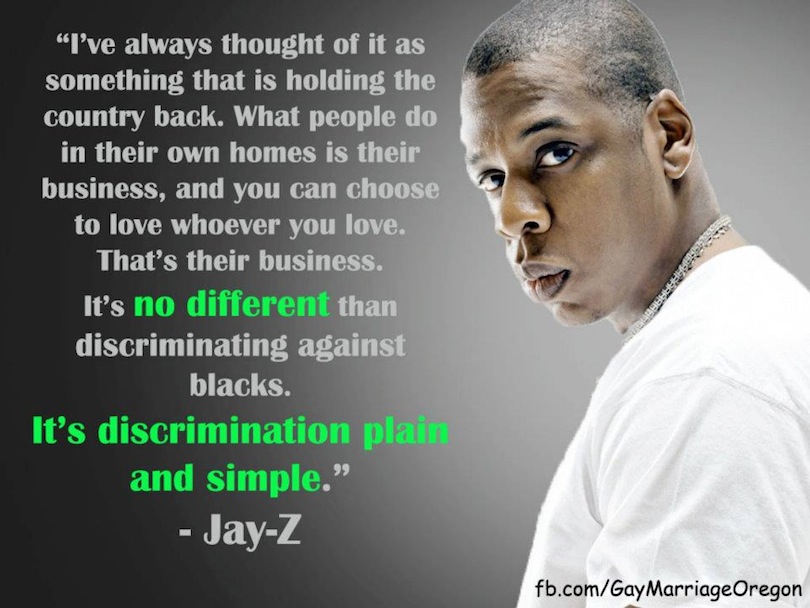
Jay Z's Down-To-Earth Take On Gay Marriage


What's your thoughts? Let us know in the comments. 

Obama 2.0: Smarter, tougher -- but wiser?


On the eve of his second inaugural, President Obama appears smarter, tougher and bolder than ever before. But whether he is also wiser remains a key question for his new term.
It is clear that he is consciously changing his leadership style heading into the next four years. Weeks before the November elections, his top advisers were signaling that he intended to be a different kind of president in his second term. CNN has more.

Thursday, January 17, 2013

Marco Rubio: President Obama Lacks “Courage” On Guns


Florida Senator Marco Rubio somehow thinks he knows how the president really feels about guns, and just doesn’t have the “courage” to say so.
“Look, I have questions about whether he’s truly committed to the Second Amendment as I understand it and most Americans would understand it. I don’t think he has the political courage to admit that,” Rubio said on Fox News.
He continued: “But ultimately, I’m not worried that he’s going to repeal the Second Amendment in terms of the law. I don’t think they’re going to do that. I do think, however, that if they don’t fully understand the Second Amendment and how it’s supposed to be applied — they are willing to test it, and they are willing to see how much they can infringe upon it.”
So, if President Obama came out for repeal of the Second Amendment, would Rubio call him “courageous”? http://bcove.me/cxt6dike

Editorial: Gun Control and the Path Forward

"The World Has Changed And It's Demanding Action"
Vice President Joe Biden 1/16/13

On January 16th 2013, shortly over a month since the Newtown Connecticut shooting at Sandy Hook Elementary School, President Barack Obama released a series of proposals and announced 23 various 'Executive Actions' that he would take immediately to combat the very real problem of guns in America. Days before and minutes after this announcement gun rights groups began their assault on the plan. As the nation continues to grapple with the increased gun violence in recent years the path forward remains murky at best. 

The Opposition

  • The National Rifle Association (NRA) has pledged that this will be the "fight of the century." The White House would do wise to take them seriously. For decades the NRA has been a strong voice of gun rights advocacy effectively stopping legislation that would ban specific weaponry or place severe limitations on a firearm owners' right to bear arms. Armed with 3.6 million members (and growing) the NRA speaks for a segment of the country. They can utilize this power to push on legislators to vote against or for legislation as the organization sees appropriate. 
  • The Constitution will be a double edged sword for this administration. It clearly states that ".... the right of the people to keep and bear Arms, shall not be infringed" For 250 years scholars and smarter men than us have deliberated over what rights and or limitations the 2nd Amendment of the Constitution allows for. There have been thousand page books written on the subject and still at the end there are those left to wonder. For the liberal wing of the country the Constitution is clear, and for the conservative wing it is just as clear. As the Obama administration tries to navigate the already treacherous waters of gun control they'll have to tread even more cautiously with this one. 
  • Republicans in the country have long been full unabridged supporters of the 2nd Amendment and it's affirmation of the right of all citizens to keep and carry weapons. With a republican controlled House of Representatives and a filibuster-capable number in the Senate any attempts to pass legislation through Congress will surely be met with opposition. Beyond the United States Congress there lies another lurking monster: republican governors. Governors in states like Texas, Arizona, Florida, Louisiana and elsewhere have preemptively stated they will meet any federal action with powerful state authority. Within the respective states also lies the issue of republicans in the State Assemblies and Senate. Even in democratic states like Oregon and Michigan the threat of obstruction by republicans in the state legislature could stop any action taken federally or by the state. Referring back to the Constitution the issue of who has more authority: States or the Federal Government arises yet again, perhaps more so than ever when it comes to gun control. Beyond the legislature aspect there still lies the "Unconstitutional" threat from Supreme Court justices. Whatever is passed can always be challenged  by citizens upset with the law and it is very likely that the Supreme Court rule gun control legislation unconstitutional. 
  • Democrats can also be a source of opposition to the administration. Even before the White House had released it's proposals some top democrats were labeling various possibilities as 'non-starters' in the quest for greater gun control. Most notable among these is Senate Majority Leader Harry Reid (D-NV) who practically threw out the notion of an assault weapons ban because although it would "possibly pass the Senate. It would almost surely die in the House." Democrats nationwide have denounced Senator Reid, some calling him a coward. Senator Reid carries a B rating with the NRA having long been a gun rights advocate. In 2010 when running for re-election he reaffirmed his support of gun rights for citizens not just in Nevada  but nationwide. 

The Path Forward

  • "It is better to win ugly than lose nobly" says Politico's Glenn Thrush. That may be true for this administration in it's attempt to pass more gun control. Any legislation passed would be the biggest change to gun laws in a generation and that in and of itself would be a challenge. Up against the aforementioned opposition this administration may have to settle for at least having tried to do something and running on that in 2014 then a renewed push for gun legislation if the democrats can retain the Senate and win back the House. 
  • Executive Actions are a sure way forward for the administration. Left unchecked they can have some real impact in the way the federal government conducts business concerning gun laws already on the books. On Wednesday when President Obama signed his 23 Executive Actions there was no mention of Executive Orders, which are more controversial especially for this administration.
  • The Constitution as mentioned above will be a double edged sword. The first segment of the Second Amendment provides that "A well regulated Militia, being necessary to the security of a free State..." however we all know what the second part of that says. As mentioned above historians and scholars have debated what interpretations the Constitution allows for the 2nd Amendment for two centuries and the answer remains just as hazy.
  • Democrats will surely be a necessary source of support in the push for more gun control. For decades gun control advocates have been seeking strong leadership and with President Obama they may have found their answer. 
  • Republicans as well could be helpful. Following Sandy Hook many longtime gun rights advocates came out in support of new common sense gun control legislation.
To say the least the path forward for the Obama Administration will be bumpy, full of many curves and long. There is bound to be some political blood shed on  both sides of the aisle. What is worth noting however is that President Obama first pledged to take action just after the shooting at Newtown and a month later he did. What remains to be seen is where his suggestions will go in a divided Congress. If even one part of his suggestions is passed though it will surely be a benchmark of this administration's power. Going into this battle the country is nearly split down the middle about what to do, but public polling suggests the public is on the side of the White House: action must be taken. One caveat to Vice President Biden's statement that "The world is changing and it's demanding action" is the simple facts of America. America has a tendency to change when it is ready to and not when the world is. In fact it is usually the case that America pushes on the world to change. While the world may be demanding action and the greater public as well the truth is that we are a Representative Democracy and not a True Democracy. Although one of the freest and truest nations in the history of the world that will serve as a roadblock to future gun control efforts. The stubbornness of a few: 535 in Congress, One President, and 9 Justices will always jeopardize the accurate representation of the country.