Showing posts with label Syria. Show all posts

Friday, May 10, 2013

The ACN Morning Report -- Friday May 10, 2013

ASSAD SEEKS HEZBOLLAH SUPPORT -- BANGLADESH BUILDING COLLAPSE DEATH TOLL RISES -- NORTH KOREA LAYS OUT CASE AGAINST JAILED AMERICAN -- U.S. NOT SEEKING PERMANENT BASES IN AFGHANISTAN -- OHIO SUSPECT'S RELATIVES SAY HE BEAT THEM -- 7 YEAR OLD BOSTON BOMBING VICTIM HAS 11TH SURGERY -- RAND PAUL, JEB BUSH, MARCO RUBIO AND PAUL RYAN -- GAY MARRIAGE BILL HEADS TO MINN. SENATE -- 3D PRINTED LIBERATOR GUN ATTRACTS TENS OF THOUSANDS

AFTER SYRIA, ASSAD SEEKS HEZBOLLAH SUPPORT

Screenshot Photo
Israel’s alleged attack against Syria seems to have led President Bashar Assad to hunker down and more fully align his regime with the Iran-Hezbollah axis. As he fights for his regime’s survival, holding on to what some analysts say could become an Alawite ministate, he is publicly moving to a more hostile position vis-à-vis Israel and the West.
Assad told a local Lebanese paper that Syria was becoming a resistance state similar to the one Hezbollah has created in Lebanon.

DEATH TOLL FROM BANGLADESH BUILDING COLLAPSE TOPS 1,000

CNN
Dhaka, Bangladesh (CNN) -- More than two weeks after a building in Bangladesh housing factories full of garment workers caved in, the death toll from the South Asian nation's deadliest industrial disaster has surpassed 1,000, authorities said Friday.
For the 17th day, rescue and recovery workers are searching through the nine-story building's tangled wreckage in Savar, a suburb of the capital, Dhaka. During the first several days of dangerous and painstaking work, they got more than 2,400 people out of the rubble alive.

NORTH KOREA DETAILS CHARGES AGAINST JAILED AMERICAN

Reuters
North Korea provided more detail on the alleged activities of jailed American Kenneth Bae early Friday, accusing him of a multiyear effort to foment opposition to the regime that appears to darken prospects for his release.
One thing that wasn’t a surprise was apparent confirmation of his involvement in missionary work, something that has seen other Korean-Americans detained in North Korea in recent years.

SPOKESMAN: U.S. NOT SEEKING PERMANENT BASES IN AFGHANISTAN

WASHINGTON, May 9 (Xinhua) -- The United States is not seeking permanent military bases in Afghanistan, and any future American presence in the country will be possible only at the invitation of the Afghan government, White House spokesman Jay Carney said here on Thursday.
The spokesman echoed what U.S. President Barack Obama said in response to a statement made by Afghan President Hamid Karzai earlier in the day about Washington's intention to set up nine military bases across the Asian nation after the exit of most U.S. and NATO combat troops by the end of 2014.

OHIO MAN'S EX-RELATIVES SAY HE BEAT THEM, KEPT MANNEQUIN IN HOME

AP
The man accused of holding three women captive for a decade in his Cleveland home terrorized the mother of his children, frequently beating her, playing twisted psychological games and locking her indoors in the years before their relationship disintegrated, her relatives say.

Several relatives of Grimilda Figueroa, who left Ariel Castro years ago and died after a long illness last year, painted a nightmarish portrait of Castro's family life as authorities made public horrifying details of the abuse endured by the imprisoned women.

 SISTER OF BOSTON BOY KILLED IN BOMBING HAS 11TH SURGERY

AP
Jane Richard, the wounded 7-year-old sister of the boy killed in the Boston Marathon bombings, had a crucial 11th surgery Wednesday night but faces more operations to prepare her for an artificial leg, the family said Thursday.
Doctors at Boston Children's Hospital finally closed the wound where one bomb tore off her left leg below the knee April 15, the Richard family wrote on its Tumblr page. She will eventually be fitted with a prosthetic device.


GOP'S RAND PAUL STEPS TOWARD 2016 RUN, JOINS GROWING FIELD

AP
DES MOINES, Iowa — Sen. Rand Paul says he’s only “considering” running for president. But he’s doing much more than mull it over.
The Kentucky Republican is unabashedly clearing a path to seek the 2016 GOP presidential nomination, with a series of early voting state visits, a beefed-up political operation and a deliberate plan to appeal to mainstream voters and raise his national profile.

MINNESOTA SENATE NEXT STOP FOR GAY MARRIAGE BILL

Photo: Jim Mone
ST. PAUL, Minn. (AP) — Gay marriage supporters in Minnesota are already in celebration mode after the state House's passage of the bill to legalize it, but there are a few more steps before it gets to the desk of Gov. Mark Dayton.

"It's not time to uncork the champagne yet. But it's chilling," said Rep. Steve Simon, DFL-Hopkins, at a spirited rally in the Capitol rotunda a few minutes after the House voted 75-59 to let same-sex couples start getting married in Minnesota come Aug. 1.


DOWNLOADS FOR 3D PRINTED LIBERATOR GUN REACHES 100,000

The blueprint used to produce a 3D-printed plastic gun has been downloaded about 100,000 times since going online earlier this week, according to Forbes.
Defense Distributed told the news site it was surprised by the amount of interest its Liberator gun had generated.
Earlier in the week, the company demonstrated the firearm being fired
But even before any more guns come off the DIY printing presses, there are moves afoot to ban it.

Monday, May 6, 2013

U.N. has testimony that Syrian rebels used sarin gas: investigator

WIRED Image

(Reuters) - U.N. human rights investigators have gathered testimony from casualties of Syria's civil war and medical staff indicating that rebel forces have used the nerve agent sarin, one of the lead investigators said on Sunday.
The United Nations independent commission of inquiry on Syria has not yet seen evidence of government forces having used chemical weapons, which are banned under international law, said commission member Carla Del Ponte.
"Our investigators have been in neighboring countries interviewing victims, doctors and field hospitals and, according to their report of last week which I have seen, there are strong, concrete suspicions but not yet incontrovertible proof of the use of sarin gas, from the way the victims were treated," Del Ponte said in an interview with Swiss-Italian television.
"This was use on the part of the opposition, the rebels, not by the government authorities," she added, speaking in Italian.
Del Ponte, a former Swiss attorney-general who also served as prosecutor of the International Criminal Tribunal for the former Yugoslavia, gave no details as to when or where sarin may have been used.
The Geneva-based inquiry into war crimes and other human rights violations is separate from an investigation of the alleged use of chemical weapons in Syria instigated by U.N. Secretary-General Ban Ki-moon, which has since stalled.
President Bashar al-Assad's government and the rebels accuse each another of carrying out three chemical weapon attacks, one near Aleppo and another near Damascus, both in March, and another in Homs in December.
The civil war began with anti-government protests in March 2011. The conflict has now claimed an estimated 70,000 lives and forced 1.2 million Syrian refugees to flee.
The United States has said it has "varying degrees of confidence" that sarin has been used by Syria's government on its people.
President Barack Obama last year declared that the use or deployment of chemical weapons by Assad would cross a "red line".
(Reporting by Stephanie Nebehay; Editing by Tom Pfeiffer)

Saturday, May 4, 2013

Assad "to delcare war" on Israel -- Explosion Rocks Damascus; Israeli Jet Shot Down


BREAKING: Eye witnesses in capital city of say military has dropped nuclear-type bomb.


THIS IS A BREAKING STORY. STAY TUNED FOR UPDATES.


Following evidence of chemical warfare and an increasingly reticent US position, Israel has in recent days taken widely reported steps to neutralise threats emanating from within civil war-torn Syria.

While strikes from Lebanese airspace this weekend are not thought to have been on chemical weapons caches, the recent Israeli intelligence regarding the use of such weaponry is thought to have spurred on a round of strikes, including the latest just hours ago.

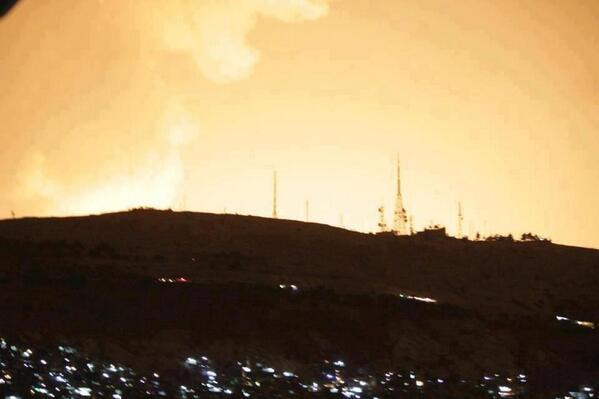
Syrian state television has reported that a major strike on an ammunition depot in Qassiyoun mountains shook Damascus, while Hezbollah's Al-Manar station claimed the explosion may have been a downed Israeli jet.

Rumours are surfacing online that following the latest volley of attacks on the Syrian regime, President Bashar al-Assad will soon officially declare war on Israel, with speculators pointing to 5am local time for official confirmation. This information continues to persist despite the technical state of war that currently exists between the two states.

Many however, have been quick to dismiss these reports as strictly rumour, with various commentators claiming that such a move would be sure to end Assad's reign of terror in Syria "within a week".

The news of an Israeli intervention in Syria has caught the Obama administration on the back foot, with the US president refusing to comment at length about the strike. Obama said, "The Israelis, justifiably, have to guard against the transfer of advanced weaponry to terrorist organizations like Hezbollah."

The US president made no mention of supposed "red lines" being crossed, despite evidence of Syria's used of chemical weapons against rebel forces. Critics have hit out at Barack Obama in recent days for failing to put forward any coherent strategy to bring the violence in Syria to an end.

The inaction, according to some, is another example of Obama's "lead from behind" strategy, the same tactic he employed during the intervention in Libya.

This has been an updated report on the original article below. 


Syrian state television has reported that a series of heavy explosions in the capital were caused by Israeli rocket strikes.


An Israeli warplane was shot down by Syrian air-defense unit during a raid near Damascus early Sunday, Hezbollah's Manar television station reported, citing security sources in the Syrian capital.
There was no independent confirmation of the claim.

State television said the blasts early Sunday morning targeted a military research centre on the outskirts of the capital. The research centre in Jamraya was the target of an earlier Israeli strike in January.

"The new Israeli attack is an attempt to raise the morale of the terrorist groups which have been reeling from strikes by our noble army," Syrian television said, referring to recent offensives by the forces of Bashar al-Assad, the Syrian president, against the armed opposition.

A Damascus resident described the blasts to Al Jazeera, saying they felt like "an earthquake" and "unprecedented".

There was no immediate comment from Israeli officials on Sunday's explosions.
"We don't respond to this kind of report," an Israeli military spokeswoman told the Reuters news agency.

The US State Department had no immediate comment and the Israeli Embassy in Washington declined comment.

The Syrian Observatory for Human Rights, a London-based watchdog group, has also reported several explosions in the capital and its surrounding countryside.

The Syrian state media claims, reported by the Reuters news agency, come after Israel confirmed that its air force hit a shipment of missiles in Syria bound for Hezbollah.

Friday, May 3, 2013

Syria and Chemical Weapons: The United States and Israel Don't Have A Leg To Stand On

Red lines are all the rage -- whether it's Obama's "red line" for Syrian chemical weapons, of Israel's Netanyahu, here, for Iran's non-existent nuclear weapons. With war threatened in both cases without a shred of evidence.

If, as alleged, the Syrian regime has used chemical weapons, it would indeed be a serious development, constituting a breach of the Geneva Protocol of 1925, one of the world’s most important disarmament treaties, which banned the use of chemical weapons.
In 1993, the international community came together to ratify the Chemical Weapons Convention, a binding international treaty that would also prohibit the development, production, acquisition, stockpiling, retention, and transfer or use of chemical weapons. Syria is one of only eight of the world’s 193 countries not party to the convention.
However, US policy regarding chemical weapons has been so inconsistent and politicized that the United States is in no position to take leadership in response to any use of such weaponry by Syria.
The controversy over Syria’s chemical weapons stockpiles is not new. Both the Bush administration and Congress, in the 2003 Syria Accountability Act, raised the issue of Syria’s chemical weapons stockpiles, specifically Syria's refusal to ratify the Chemical Weapons Convention. The failure of Syria to end its chemical weapons program was deemed sufficient grounds by a large bipartisan majority of Congress to impose strict sanctions on that country.
Syria rejected such calls for unilateral disarmament on the grounds that it was not the only country in the region that had failed to sign the CWC—nor was it the first country in the region to develop chemical weapons, nor did it have the largest chemical weapons arsenal in the region.
Indeed, neither Israel nor Egypt, the world’s two largest recipients of US military aid, is a party to the convention either. Never has Congress or any administration of either party called on Israel or Egypt to disarm their chemical weapons arsenals, much less threatened sanctions for having failed to do so. US policy, therefore, appears to be that while it is legitimate for its allies Israel and Egypt to refuse to ratify this important arms control convention, Syria needed to be singled out for punishment for its refusal.
The first country in the Middle East to obtain and use chemical weapons was Egypt, which used phosgene and mustard gas in the mid-1960s during its intervention in Yemen’s civil war. There is no indication Egypt has ever destroyed any of its chemical agents or weapons. The US-backed Mubarak regime continued its chemical weapons research and development program until its ouster in a popular uprising two years ago, and the program is believed to have continued subsequently.
Israel is widely believed to have produced and stockpiled an extensive range of chemical weapons and is engaged in ongoing research and development of additional chemical weaponry. (Israel is also believed to maintain a sophisticated biological weapons program, which is widely thought to include anthrax and more advanced weaponized agents and other toxins, as well as a sizable nuclear weapons arsenal with sophisticated delivery systems.)
For more than 45 years, the Syrians have witnessed successive US administration provide massive amounts of armaments to a neighboring country with a vastly superior military capability which has invaded, occupied, and colonized Syria's Golan province in the southwest. In 2007, the United States successfully pressured Israel to reject peace overtures from the Syrian government in which the Syrians offered to recognize Israel and agree to strict security guarantees in return for a complete Israeli withdrawal from occupied Syrian territory.
The US position that Syria must unilaterally give up its chemical weapons and missiles while allowing a powerful and hostile neighbor to maintain and expand its sizable arsenal of nuclear, chemical, and biological weapons is simply unreasonable. No country, whether autocratic or democratic, could be expected to accept such conditions.
This is part of a longstanding pattern of hostility by the United States towards international efforts to eliminate chemical weapons through a universal disarmament regime. Instead, Washington uses the alleged threat from chemical weapons as an excuse to target specific countries whose governments are seen as hostile to US political and economic interests.
One of the most effective instruments for international arms control in recent years has been the Organization for the Prohibition of Chemical Weapons (OPCW), which enforces the Chemical Weapons Convention by inspecting laboratories, factories, and arsenals, and oversees the destruction of chemical weapons. The organization’s most successful director general, first elected in 1997, was the Brazilian diplomat Jose Bustani, praised by the Guardian newspaper as a “workaholic” who has “done more in the past five years to promote world peace than anyone.”
Under his strong leadership, the number of signatories of the treaty grew from 87 to 145 nations, the fastest growth rate of any international organization in recent decades, and – during this same period – his inspectors oversaw the destruction of 2 million chemical weapons and two-thirds of the world’s chemical weapons facilities. Bustani was re-elected unanimously in May 2000 for a five-year term and was complimented by Secretary of State Colin Powell for his “very impressive” work.
However, by 2002, the United States began raising objections to Bustani’s insistence that the OPCW inspect US chemical weapons facilities with the same vigor it does for other signatories. More critically, the United States was concerned about Bustani’s efforts to get Iraq to sign the convention and open their facilities to surprise inspections as is done with other signatories. If Iraq did so, and the OPCW failed to locate evidence of chemical weapons that Washington claimed Saddam Hussein’s regime possessed, it would severely weaken American claims that Iraq was developing chemical weapons.
US efforts to remove Bustani by forcing a recall by the Brazilian government failed, as did a US-sponsored vote of no confidence at the United Nations in March. That April, the United States began putting enormous pressure on some of the UN’s weaker countries to support its campaign to oust Bustani and threatened to withhold the United States’ financial contribution to the OPCW, which constituted more than 20 percent of its entire budget. Figuring it was better to get rid of its leader than risk the viability of the whole organization, a majority of nations, brought together in an unprecedented special session called by the United States, voted to remove Bustani.
The Case of Iraq
The first country to allegedly use chemical weapons in the Middle East was Great Britain in 1920, as part of its efforts to put down a rebellion by Iraqi tribesmen when British forces seized the country following the collapse of the Ottoman Empire. According to Winston Churchill, who then held the position of Britain’s Secretary of State for War and Air, "I do not understand this squeamishness about the use of gas. I am strongly in favour of using poisonous gas against uncivilised tribes.”
It was the Iraqi regime of Saddam Hussein, during the Iran-Iraq War in the 1980s, that used chemical weapons on a scale far greater than any country had dared since the weapons were banned nearly 90 years ago. The Iraqis inflicted close to 100,000 casualties among Iranian soldiers using banned chemical agents, resulting in 20,000 deaths and tens of thousands of long-term injuries.
They were unable to do this alone, however. Despite ongoing Iraqi support for Abu Nidal and other terrorist groups during the 1980s, the Reagan administration removed Iraq from the State Department’s list of state sponsors of terrorism in order to provide the regime with thiodiglycol, a key component in the manufacture of mustard gas, and other chemical precursors for their weapons program.
Walter Lang, a senior official with the US Defense Intelligence Agency, noted how "the use of gas on the battlefield by the Iraqis was not a matter of deep strategic concern" to President Reagan and other administration officials since they "were desperate to make sure that Iraq did not lose." Lang noted that the DIA believed Iraq’s use of chemical was “seen as inevitable in the Iraqi struggle for survival.” In fact, DIA personnel were dispatched to Baghdad during the war to provide Saddam Hussein’s regime with US satellite data on the location of Iranian troop concentrations in the full knowledge that the Iraqis were using chemical weapons against them.
Even the Iraqi regime’s use of chemical weapons against civilians was not seen as particularly problematic. The March 1988 massacre in the northern Iraqi city of Halabja, where Saddam's forces murdered up to 5,000 Kurdish civilians with chemical weapons, was downplayed by the Reagan administration, with some officials even falsely claiming that Iran was actually responsible. The United States continued sending aid to Iraq even after the regime’s use of poison gas was confirmed. 
When a 1988 Senate Foreign Relations committee staff report brought to light Saddam's policy of widespread extermination in Iraqi Kurdistan, Senator Claiborne Pell introduced the Prevention of Genocide Act to put pressure on the Iraqi regime, but the Bush administration successfully moved to have the measure killed. This came despite evidence emerging from UN reports in 1986 and 1987, prior to the Halabja tragedy, documenting Iraq's use of chemical weapons against Kurdish civilians—allegations that were confirmed both by investigations from the CIA and from US embassy staff who had visited Iraqi Kurdish refugees in Turkey. However, not only was the United States not particularly concerned about Iraq’s use of chemical weapons, the Reagan administration continued supporting the Iraqi government's procurement effort of materials necessary for their development.
Given the US culpability in the deaths of tens of thousands of people by Iraqi chemical weapons less than 25 years ago, the growing calls for the United States to go to war with Syria in response to that regime’s alleged use of chemical weapons that killed a few dozen people leads even many of Syrian dictator Bashar Assad’s fiercest opponents to question US motivations.
This is not the only reason US credibility on the issue of chemical weapons is questionable, however.
After denying and covering up Iraq’s use of chemical weapons in the late 1980s, the US government—first under President Bill Clinton and then under President George W. Bush—began insisting that Iraq’s alleged chemical weapons stockpile was a dire threat, even though the country had completely destroyed its stockpile by 1993 and completely dismantled its chemical weapons program.
Vice President Joe Biden, Secretary of State John Kerry, and Secretary of Defense Chuck Hagel—when they served in the US Senate in 2002—all voted to authorize the US invasion of Iraq, insisting that Iraq still had a chemical weapons arsenal that was so extensive it constituted a serious threaten to the national security of the United States, despite the fact that Iraq had rid itself of all such weapons nearly a decade earlier. As a result, it is not unreasonable to question the accuracy of any claims they might make today in regard to Syria’s alleged use of chemical weapons.
It should also be noted that many of today’s most outspoken congressional advocates for US military intervention in Syria in response to the Damascus regime’s alleged use of chemical weapons were among the most strident advocates in 2002-2003 for invading Iraq. Rep. Eliot Engel (D-NY), whom the Democrats have chosen to be their ranking member on the House Foreign Affairs Committee, was among the right-wing minority of House Democrats who voted to authorize the invasion of Iraq on the grounds that the country possessed weapons of mass destruction. When no such weapons were found, Engel came up with the bizarre allegation that “it would not surprise me if those weapons of mass destruction that we cannot find in Iraq wound up and are today in Syria.”
Engel is currently the chief sponsor of the Free Syria Act of 2013 (H.R. 1327), which would authorize the United States to provide arms to Syrian rebels.
UN resolutions
Unlike the case of Saddam Hussein’s Iraq, there are no UN Security Council resolutions specifically demanding that Syria unilaterally disarm its chemical weapons or dismantle its chemical weapons program. Syria is believed to have developed its chemical weapons program only after Israel first developed its chemical, biological, and nuclear programs, all of which still exist today and by which the Syrians still feel threatened.
However, UN Security Council Resolution 687, the resolution passed at the end of the 1991 Gulf War demanding the destruction of Iraq’s chemical weapons arsenal, also called on member states “to work towards the establishment in the Middle East of a zone free of such weapons.”
Syria has joined virtually all other Arab states in calling for such a “weapons of mass destruction-free zone” for the entire Middle East. In December 2003, Syria introduced a UN Security Council resolution reiterating this clause from 12 years earlier, but the resolution was tabled as a result of a threatened US veto. As I wrote at time, in reference to the Syrian Accountability Act, “By imposing strict sanctions on Syria for failing to disarm unilaterally, the administration and Congress has roundly rejected the concept of a WMD-free zone or any kind of regional arms control regime. Instead, the United States government is asserting that it has the authority to say which country can have what kind of weapons systems, thereby enforcing a kind of WMD apartheid, which will more likely encourage, rather than discourage, the proliferation of such dangerous weapons.”
A case can be made, then, that had the United States pursued a policy that addressed the proliferation of non-conventional weapons through region-wide disarmament rather than trying to single out Syria, the Syrian regime would have rid itself of its chemical weapons some years earlier along with Israel and Egypt, and the government’s alleged use of such ordnance—which is now propelling the United States to increase its involvement in that country’s civil war—would have never become an issue.


Obama: Ground Troops Unlikely


US Officials: Israel Conducting Air Strikes In Syria


The United States believes Israel has conducted an airstrike into Syria, CNN reported on Friday, citing two unnamed US officials.
CNN quoted the officials as saying Israel most likely conducted the strike "in the Thursday-Friday time frame" and that Israel's warplanes did not enter Syrian airspace.
There was no immediate confirmation. A White House spokeswoman referred questions on the CNN report to the Israeli government.It said the officials did not believe Israel had targeted a chemical weapons facility. US and Western intelligence bodies were reviewing classified information surrounding the incident, according to the CNN report.
The NBC news network cited US officials who said Israel launched airstrikes against Syria on Friday and that Israel's primary target was a shipment of weapons headed for Hezbollah in Lebanon.
According to the NBC report, a senior US official said the airstrikes were thought to be related to "delivery systems for chemical weapons."
A third American news network, CBS News, cited US sources as saying Israel targeted a warehouse.
In Jerusalem, an Israeli defense official declined comment, and a military spokeswoman said, "We do not comment on reports of this kind."
A spokesman for the Israeli Embassy in Washington said, "We cannot comment on these reports, but what we can say is that Israel is determined to prevent the transfer of chemical weapons or other game-changing weaponry by the Syrian regime to terrorists, especially to Hezbollah in Lebanon."
Syria's envoy to the UN said on Friday he was not aware of any attack by Israel against his country.
"I'm not aware of any attack right now," Syria's UN ambassador, Bashar Ja'afari said.
The CNN report said that during the time frame of the attack, the United States had collected information showing Israeli warplanes overflying Lebanon. 
IAF warplanes flew over southern Lebanon at low altitudes on Friday morning, Lebanon's official National News Agency reported.
The planes flew over the town of Bint Jbeil in the Nabatiye Governorate of southern Lebanon, according to the report.
Israel has made clear in the past that it might intervene to prevent Syrian advanced weapons falling into the hands of militant groups, including Lebanon's Hezbollah, which fought a 34-day war with Israel in 2006.
In January this year, Israel bombed a convoy in Syria, apparently hitting weapons destined for Hezbollah, according to diplomats, Syrian rebels and security sources in the region

Thursday, March 21, 2013

The ACN Morning Report Friday March 22 2013

GOOD MORNING! TODAY IS FRIDAY MARCH 22, 2013. HERE ARE TODAY'S TOP HEADLINES AND MOST INTERESTING STORIES FROM ACN: 

Colorado Shooting Suspect Shot -- U.S. Pediatricians And Gay Marriage -- New York Budget Deal Could Set Mold For Nation -- Pro Assad Preacher Killed -- Shooting At Virginia Base -- NRA Joins Lawsuit Challenging NY Gun Law -- Colorado Legalizes Civil Unions

COLORADO SHOOTING SUSPECT SHOT AND KILLED IN TEXAS

Associated Press
DENVER — A paroled Colorado inmate grievously wounded after a gun battle and high-speed chase with Texas law-enforcement officers on Thursday is suspected of being tied to the killing of the head of Colorado’s prison system.

Sheriff David Walker of Wise County, Tex., said the authorities had tentatively identified the suspect as Evan Spencer Ebel, 28. Court records in Colorado show that Mr. Ebel has a criminal history dating to 2003, including convictions for robbery, weapons charges and assault. He was on parole in the Denver area.

U.S. Pediatricians Back Gay Marriage, Adoption Rights

Reuters
(Reuters) - Gay and lesbian couples should be able to get married for the health and well-being of their children and families, the nation's leading group for pediatricians said on Thursday in a policy statement that also backs adoption rights.
The American Academy of Pediatrics, in calling on the legal right for same-sex couples to marry, said children's well-being is affected far more by other factors such as their parents' health and economic security than their sexual orientation.

NEW YORK BUDGET DEAL INCLUDES MINIMUM WAGE HIKE, TAX BREAKS

Reuters
(Reuters) - New York state's leaders have agreed to a tentative $135 billion budget deal that raises the minimum wage, gives tax breaks to middle-class families and businesses, and extends a tax on high earners.
The deal for fiscal year 2013-14 was announced in Albany, the state capital, late Wednesday after days of closed-door wrangling as lawmakers sought to reconcile three separate proposals.

BOMBING KILLS TOP PRO ASSAD SUNNI PREACHER IN SYRIA

A suicide bomb ripped through a mosque in the heart of the Syrian capital Thursday, killing a top Sunni Muslim preacher and outspoken supporter of President Bashar Assad in one of the most stunning assassinations of Syria's 2-year-old civil war. 

The slaying of Sheikh Mohammad Said Ramadan al-Buti removes one of the few remaining pillars of support for Assad among the majority Sunni sect that has risen up against him.

VIRGINIA MARINE CORPS BASE ON LOCKDOWN AFTER SHOOTING

The Marine Corps base in Quantico, Va., was on lockdown early Friday after an isolated shooting at the Officer Candidate School, the base said. The gunman was at large but surrounded.
Base residents were ordered to stay inside and lock their doors. The threat level was boosted to FPCON Delta, the base said on its website and Facebook page. That threat level can describe an active shooter or a terrorist attack.
The suspect, believed to be a male Marine, had barricaded himself at the base and was surrounded by police, the Marines said. Prince William County and military police had responded.
First Lt. Agustin Solivan told local TV station WUSA9 that the shooting happened about 11 p.m. The victim's condition was not known.

NRA JOINS LAWSUIT CHALLENGING NEW YORK'S GUN CONTROL LAW

AP
The National Rifle Association on Thursday joined the the New York State Rifle and Pistol Association, other sportsmen's groups, firearms businesses and individual gun owners in a lawsuit challenging the state's strict new gun control law.

The federal suit, filed in Buffalo, said the law violates the constitutional rights of "law-abiding citizens to keep commonly possessed firearms in the home for defense of self and family and for other lawful purposes."

COLORADO LAW ALLOWS SAME-SEX CIVIL UNIONS IN "HATE STATE"

Governor John Hickenlooper made same-sex civil unions legal in Colorado, where two decades ago voters passed a constitutional amendment banning local ordinances to protect gay rights.
The Colorado Civil Union Act, which the Democrat-controlled legislature moved to Hickenlooper earlier this month, provides gays with rights similar to those of married couples. Applications for the licenses can be filed starting May 1.
“The gay, lesbian, transgender, bisexual community is part of all of us,” Hickenlooper, 61, told scores of cheering same- sex couples after he signed the bill at History Colorado, a museum in Denver. “There’s no excuse that people shouldn’t have the same rights,” the first-term Democrat said.

Tuesday, March 19, 2013

The ACN Morning Report Wednesday March 20, 2013

GOOD MORNING! TODAY IS WEDNESDAY MARCH 20, 2013. HERE ARE TODAY'S TOP AND MOST INTERESTING HEADLINES FROM ACN:

55 Killed In Iraq On Anniversary -- Ohio Gunman Mocks Victims' Families -- Senate Dems Drop Assault Weapons -- Cyprus Uncertainty Puts EU In Jeopardy -- Pentagon Bans 60MM Mortars After Deaths -- Contingency Plans Underway For Syria

ATTACK CLAIMS 55 LIVES ON IRAQ ANNIVERSARY

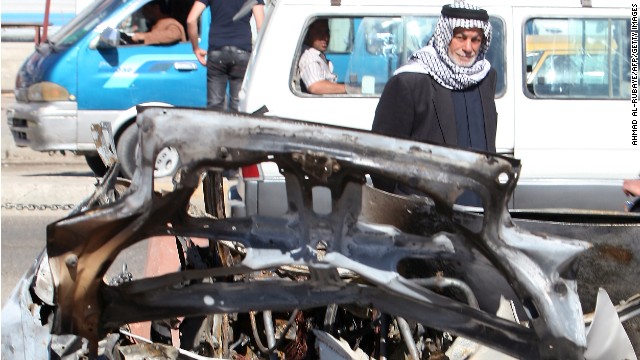
Baghdad (CNN) -- At least 55 people were killed and scores more wounded when bombs exploded across Iraq on Tuesday, a stark reminder of the violence and instability that grips the country 10 years after the start of the U.S.-led war.
The attacks -- 17 car bombs, seven roadside bombs, and two shootings -- ripped mostly through Shiite neighborhoods of Baghdad, but also struck Sunni communities in other towns. At least 187 people were wounded.

TEENAGE GUNMAN IN OHIO MOCKS VICTIMS' FAMILY 

Thomas Lane wore a T-shirt with KILLER scrawled in black ink during his sentencing Tuesday in an Ohio courtroom for shooting and killing three students in a high school cafeteria and wounding two others last year.
Mr. Lane, 18, was sentenced to three life sentences without parole. He pleaded guilty last month to opening fire on the morning of Feb. 27, 2012, with a .22-caliber Ruger semiautomatic pistol at Chardon High School while waiting for a bus to attend an alternative high school.

SENATE LEADERS DROP ASSAULT WEAPONS FROM GUN SAFETY BILL

Three months after the mass shooting of 20 children and six adults at a Connecticut elementary school outraged the nation, Senate Democratic leaders are dropping an assault-weapon ban from gun legislation.
While public opinion polls show most Americans support an assault-weapon ban, Senate Majority Leader Harry Reid said yesterday the proposal has fewer than 40 votes in the 100-member chamber. Its sponsor, California Democrat Dianne Feinstein, will be given a chance to offer the measure as an amendment to gun legislation that Democrats will introduce, second-ranking Democrat Dick Durbin told reporters.

EURO ON DEFENSIVE AS CYPRUS PARLIAMENT DISREGARDS BANK TAX, MARKETS EYE BERNANKE

(Reuters) - The euro was pinned near four-month lows against the U.S. dollar in Asia on Wednesday after Cyprus' rejection of bailout terms seemed to threaten default or even expulsion from the euro zone.
The general assumption in markets is that the European Union, as so often before, will hash out a last minute deal that keeps Cyprus in the single currency.

PENTAGON BANS 60 MM MORTAR ROUNDS 

HAWTHORNE, Nev. (AP) - A mortar shell explosion killed at least seven Marines and injured several more during mountain warfare training in Nevada's high desert, prompting the Pentagon to immediately halt the use of the weapons until an investigation can determine their safety, officials said Tuesday. The explosion occurred Monday night at the Hawthorne Army Depot, a sprawling facility used by troops heading overseas, during an exercise involving the 2nd Marine Expeditionary Force from Camp Lejeune, N.C. Several Marines from the unit were injured in the blast, authorities said.

COMMANDER: CONTINGENCY PLANS UNDERWAY FOR SYRIA

WASHINGTON (AP) -- The top U.S. military commander in Europe said Tuesday that several NATO countries are working on contingency plans for possible military action to end the two-year civil war in Syria as President Bashar Assad's regime accused U.S.-backed Syrian rebels of using chemical weapons.

The ACN Morning Report Tuesday March 19 2013


GOOD MORNING! TODAY IS TUESDAY MARCH 19TH 2013. HERE ARE TODAY'S MOST INTERESTING AND TOP STORIES FROM ACN:

Pope Francis Inauguration Mass -- Chemical Weapons In Syria? -- 10th Anniversary Of Iraq War -- Fl. Student Plotted Attack -- Hillary Clinton Comes Out On Gay Marriage -- Cyprus To Vote On Taxing Deposits -- The Bernanke Buzzkill -- NASA Curiosity Rover Suffers Glitch -- NYC Plan To "Hide" Tobacco 

Pope Francis Pleas For Poor At Inaugural Mass

Pope Francis has inaugurated his papacy at a Mass in Rome, calling on global leaders and all the people of the world to defend the poor and the weak.
Up to 200,000 people attended the Mass in St Peter's Square.
His homily focused on protection - of the environment, children, the elderly and those in need, who he said were "often the last we think about".
Francis was elected by a conclave of cardinals last week to take over from Benedict XVI.

Syria Says Rebel "Chemical Weapon" Attack Kills 6

www.chron.com
DAMASCUS, Syria (AP) — Syria's information minister says a chemical weapon fired by rebels on a village in the north of the country is the "first act" by the opposition interim government announced in Istanbul.
Omran al-Zoubi says the missile containing "poisonous gases" was fired from Nairab district in Aleppo into Khan al-Assal village on Tuesday.
He says 16 people were killed and 86 wounded in the attack. He spoke to the pro-government Al-Ikhbariya TV station.

On 10th Anniversary Of Iraq War 20 Killed, 96 Injured

BAGHDAD, March 19 (Xinhua) -- Up to 20 people were killed and more than 97 wounded in a series of bombings and shootings in central Iraq on Tuesday morning, the police said.
In Baghdad, eight car bombs ripped through crowded areas mainly in Shiite districts across the capital, killing a total of 15 people and wounding 73 others, an interior ministry source told Xinhua on condition of anonymity.
Also in the capital, two people were killed when two sticky bombs attached to their cars detonated in western and eastern Baghdad, while a third shot dead by gunmen in the southern part of Baghdad, the source said.
Meanwhile, a suicide bomber drove an explosive-laden truck into the entrance of an Iraqi army base in the town of Iskandariyah, some 50 km south of Baghdad, killing at least two people and wounding more than 10 others, a local police source anonymously told Xinhua.

Central Florida Student Plotted Attack On Other Students

FSU
Authorities say a University of Central Florida student who pulled a dorm fire alarm in the middle of the night had a more sinister plan than sending students scurrying out into the night.

Campus police said Monday that 30-year-old James Oliver Seevakumaran was armed with two guns, hundreds of rounds of ammunition, a backpack filled with explosives and a plan to attack other students as they fled the seven-story dorm where he lived.

His plans were thrown off by campus police officers' quick response to the fire alarm and a 911 call from Seevakumaran's roommate who had holed himself in a bathroom after Seevakumaran pointed a gun at him.

Hillary Clinton Comes Out On Gay Marriage

Former Secretary of State Hillary Clinton may not have declared whether she’s running for president in 2016, but her public declaration supporting gay marriage on Monday puts her on the same page with other potential Democratic candidates should she decide to run.
Clinton made the announcement in an online video released by the Human Rights Campaign. “LGBT Americans are our colleagues, our teachers, our soldiers, our friends, our loved ones, and they are full and equal citizens and deserve the rights of citizenship. That includes marriage. That’s why I support marriage for lesbian and gay couples. I support it personally and as a matter of policy and law,” she said. Clinton acknowledged her evolving position on the issue. “Like so many others, my views have been shaped over time by people I have known and loved, by my experience representing our nation on the world stage, my devotion to law and human rights, and the guiding principles of my faith.”

Cyprus Parliament Says Bank Levy Unlikely

A number of members of Cyprus's parliament have told CNBC that the legislation to tax bank deposits is unlikely to pass, a move that could potentially put the country into default.
Parliament is due to convene at 4 p.m. London time on Tuesday and despite the ruling party saying they will approve the proposal, several parties have said they will reject the levy. No single party has a majority in the 56-member chamber to push through the vote.

Fed Meeting: Bracing For Bernanke Buzzkill

Stocks are rallying, job growth is strengthening and a housing recovery is well underway -- but don't expect the Federal Reserve to back away from its stimulative policies just yet.

If anything, the Fed is likely to deliver a buzzkill after its two-day meeting wraps up Wednesday. Fed chairman Ben Bernanke will also address the state of the economy in a press conference following the release of the Fed's latest statement on interest rates and new economic forecasts.

Second Computer Glitch Stalls NASA's Mars Rover

NASA.Gov
Computerworld - After a computer glitch sidelined NASA's Mars rover Curiosity late last month, another problem has it down again.
NASA reported that Curiosity put itself into safe mode on Saturday after a software bug caused a command file to fail a size-check.
"This is a very straightforward matter to deal with," said Richard Cook, Curiosity's project manager. "We can just delete that file, which we don't need any more, and we know how to keep this from occurring in the future."
NASA said late on Monday that bringing Curiosity out of safe mode is expected to take a couple of days.

NYC Plan Would Keep Tobacco Products Hidden

AP
NEW YORK (AP) — Cigarettes would have to be kept out of sight in New York City stores under a first-in-the-nation plan unveiled by Mayor Michael Bloomberg on Monday, igniting complaints from retailers and smokers who said they've had enough with the city’s crackdowns.
Shops from corner stores to supermarkets would have to keep tobacco products in cabinets, drawers, under the counter, behind a curtain or in other concealed spots. Officials also want to stop shops from taking cigarette coupons and honoring discounts, and are proposing a minimum price for cigarettes, below what the going rate is in much of the city now, to discourage black market sales.